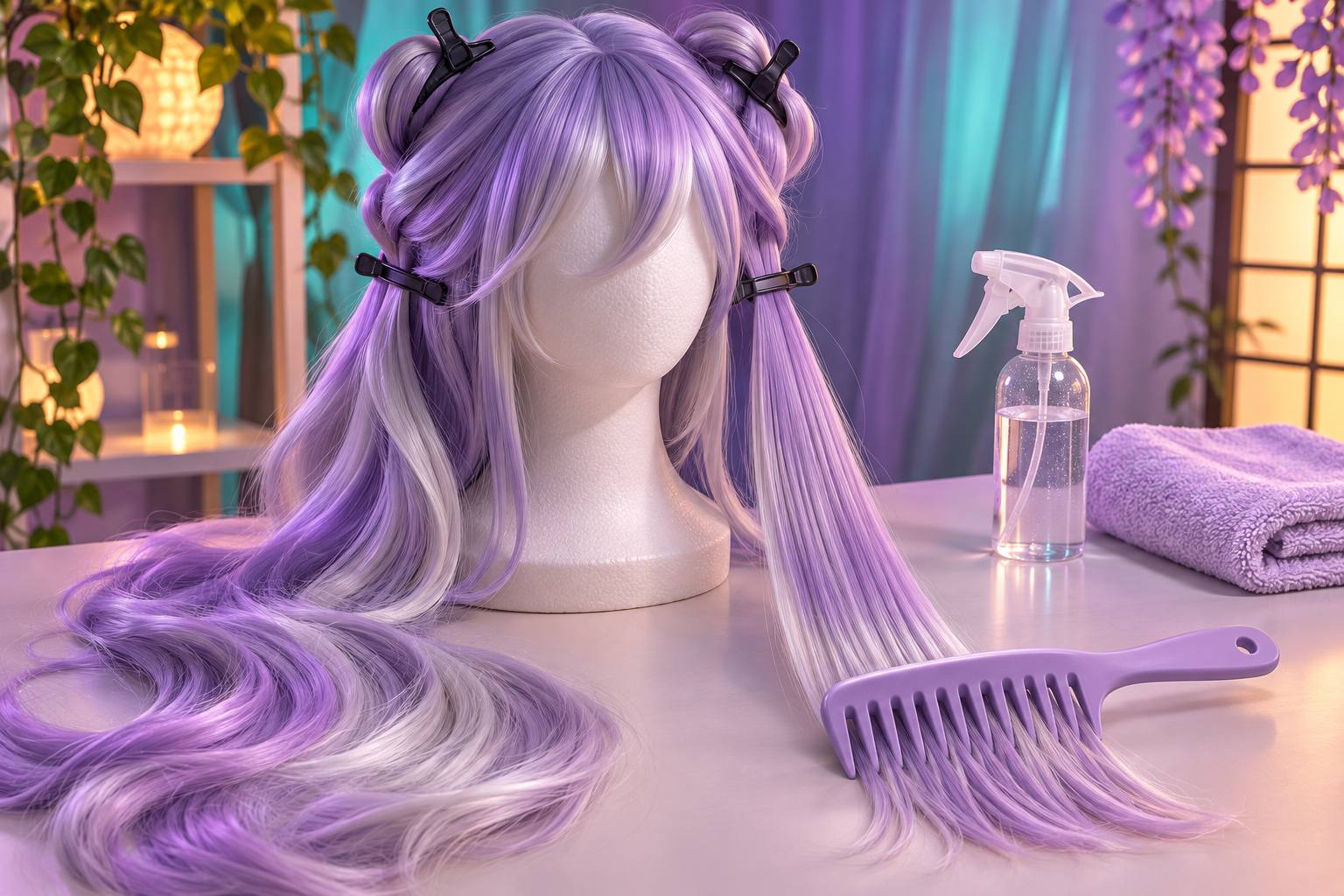

Decide whether the wig needs a full wash
A cosplay wig does not need the same wash schedule as the hair beneath it. If it was worn briefly and has no product buildup, a careful comb-through and airing may be enough. A long convention day, visible styling residue or an odor can change that decision. Check the cap as well as the visible fibers.
Epic Cosplay's care guide suggests washing its frequently worn synthetic wigs after about 10 to 15 wears, while occasional wear may need less. Jon Renau gives a different interval for its own products. Treat those as maker guidance, not a universal calendar. The condition of your wig and its own label matter more than a fixed number.
If the wig has a carefully glued shape, attached ornaments, hand-tied lace or a finish you cannot identify, pause before soaking it. Ask the seller what can be washed and which parts need to stay dry. Photograph the style from several sides so you can restore the parting and silhouette afterward.
Identify the fiber, cap and added materials
Look for a product label, order record or care card. Confirm whether the fibers are conventional synthetic, heat-friendly synthetic or human hair, and whether the cap has lace, skin-top material or adhesive. The same character style can be sold in different fibers. Appearance alone does not prove what a wig can tolerate.
Read the instructions for every attached piece, not just the hair. A painted prop, glued clip or sewn ornament may not survive immersion. Remove detachable accessories before washing, and keep them labeled so they return to the right place. If an attachment cannot be removed, ask the maker how to protect it.
Jon Renau's synthetic guide distinguishes cap care, washing and heat styling for its products. It also cautions that delicate lace can be stressed by rough handling. Use that as an example of why construction matters; follow the instructions for the wig you actually own.
Prepare a clean work area and the right supplies
Clear a sink or basin and set out the cleanser approved by your wig maker, a clean towel, a wide-tooth comb and a stand or drying rack. Remove jewelry that could snag a fiber. Keep hot tools, heaters and direct sunlight away from the drying area until you know the wig's heat tolerance.
If the care label recommends a specific product, use it. A substitute may be safe for one brand but leave residue on another. Do not add laundry detergent, bleach or an untested household solvent merely because it cleans fabric. Test any new product according to the maker's directions.
Plan for the wig to remain out of use until fully dry. A hurried wash before leaving for an event invites rough brushing or heat drying. If time is short and the wig only needs a little attention, a gentle dry detangle may be the better option.
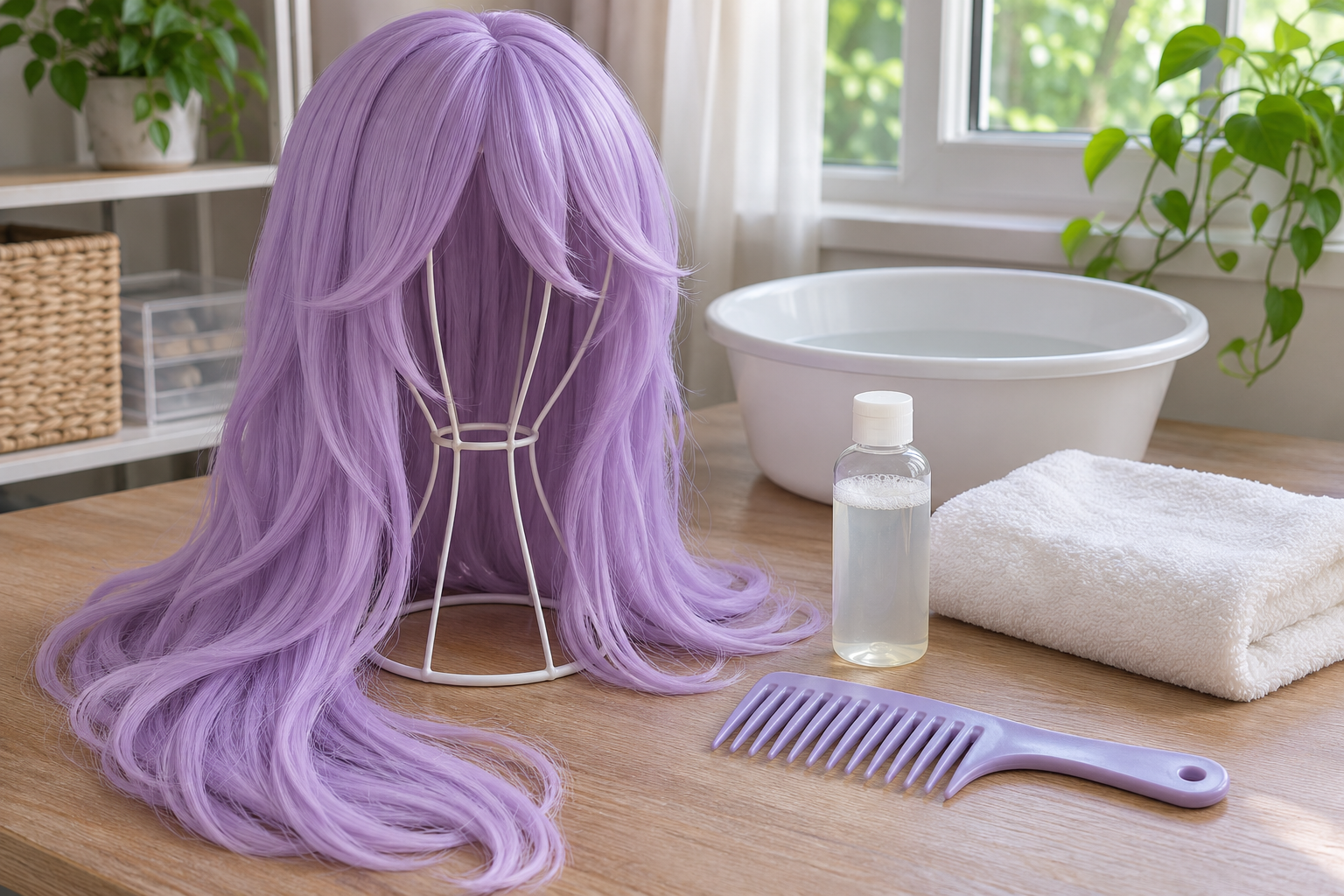
Detangle before water reaches the fibers
Begin at the ends of a dry wig, supporting the section above the knot with your other hand. Work upward in small sections using the comb or brush approved for that fiber. Pulling from the cap straight through a knot can stretch fibers and strain the stitching. Our wig detangling guide explains the approach in more detail.
Arda's FAQ recommends a wide-tooth comb or fingers from bottom to top for its wigs. It also warns that pulling can stretch fibers. Curly or heavily styled pieces may need even more care: separate a ringlet rather than dragging a comb through the whole curl.
Do not force a matted area. If a knot will not release, check whether the maker offers a detangling product or repair advice. Trim only if you are prepared to lose that section's length and shape. Washing a tight knot can make the next step harder.
Use the wash method specified for the wig
Follow the maker's water temperature, cleanser amount and soaking instructions. Many synthetic wig guides call for cool or lukewarm water and gentle movement. Arda describes swishing its wigs in gentle shampoo and avoiding hot water, which can relax curls. Wig Is Fashion's synthetic-wig guide describes cool water and a short gentle soak for its products.
Support the cap as you lower the wig. Move the fibers in the direction they normally fall rather than rubbing them against one another. Do not scrub the lace, twist the lengths or treat a heavily styled wig like a towel. Follow the actual wig label if it specifies rinsing under running water instead of soaking.
If you cannot confirm that the wig or an attached detail is washable, stop at dry cleaning steps approved by the maker and ask for advice. A generic wash method cannot establish how an unknown adhesive, dye or custom styling will behave.
Rinse without roughing up the style
Use the water temperature in the care directions and let it run through the fiber in its normal direction. Keep the cap supported so a wet, heavy length does not pull on a lace front or seam. Continue until the allowed cleanser has been removed as the maker directs.
Some wig ranges recommend a leave-in conditioner or spray, while others have different rules for the cap and roots. Do not automatically apply human-hair conditioner to every synthetic wig. Wig Is Fashion advises keeping conditioner away from lace and roots in its synthetic-wig routine because of knot concerns; follow your own wig's instructions.
If color runs unexpectedly, a glued detail loosens or the texture changes, pause. More rinsing or stronger product may make a problem worse. Record what you used and contact the maker before trying another treatment.
Remove water with a towel, not a twist
Lift the wig carefully and let excess water drain without stretching the cap. Use a clean towel to blot or roll the lengths if that matches the care instructions. Avoid wringing, which can distort fibers, curls and hand-tied areas. Pat the cap gently rather than pulling on its edges.
Arda advises patting with a towel, while Wig Is Fashion describes rolling the wig in a towel before air drying. The details differ, but both approaches avoid rough twisting. If your piece has a built-up style or delicate ornament, use the maker's directions rather than pressing it into a flat towel roll.
The wig may still feel damp after toweling. That is expected. Set it up to dry where air can move around the cap, rather than sealing it in a bag or returning it immediately to a display box.
Air dry in a shape that suits the cap
Place the wig on the stand or rack recommended for its construction. Arrange the part, fringe and lengths while they are supported, without pulling a wet fiber into a new style. Keep the stand away from a heater and direct hot airflow unless the manufacturer explicitly permits that method.
Jon Renau's synthetic care directions call for air drying on a plastic or wire stand and warn against blow drying its conventional synthetic fiber. Other fibers may be labeled heat friendly, but that label does not make every drying temperature or tool safe. Check the exact range before using heat.
Allow the cap and inner seams to dry fully. A long wig can feel dry at the ends while the cap remains damp. Use a gentle touch to check hidden areas rather than pulling the whole piece off the stand repeatedly.
Restyle only after the wig is ready
Once dry, compare the wig with your reference photographs. Begin with the part and fringe, then separate the lengths. Use the maker-approved comb or styling product. Do not assume a flat iron or hot water technique is safe for a wig just because another brand advertises heat-resistant fiber.
If the piece has curls, preserve their groupings when you detangle. For a lace front, handle the edge gently and avoid tugging on individual knots. If a spike or glued shape has collapsed, ask the original stylist or maker which product was used before applying a new layer.
Our wig styling guide covers planning a repeatable look. If you are preparing for your first event, the wearing guide also helps you check comfort and fit after the wash.
Store the clean wig for its next event
Store only when the cap and lengths are completely dry. A heavily styled wig may need a stand or roomy box; a simpler style may fit in its original packaging if the maker recommends it. Keep accessories with the wig but avoid crushing a lace edge or rigid ornament.
Write a short care note with the brand, fiber, cleanser, water temperature and drying method that worked. That record is more useful than trying to remember a generic tutorial months later. Include any added glue, paint or extension that changes the care instructions.
A careful wash begins with identification and ends with a fully dry, wearable shape. If the fiber, cap or construction remains uncertain, ask the maker before another wash. The goal is to keep the costume usable, not to force an unfamiliar wig through a standard routine.